
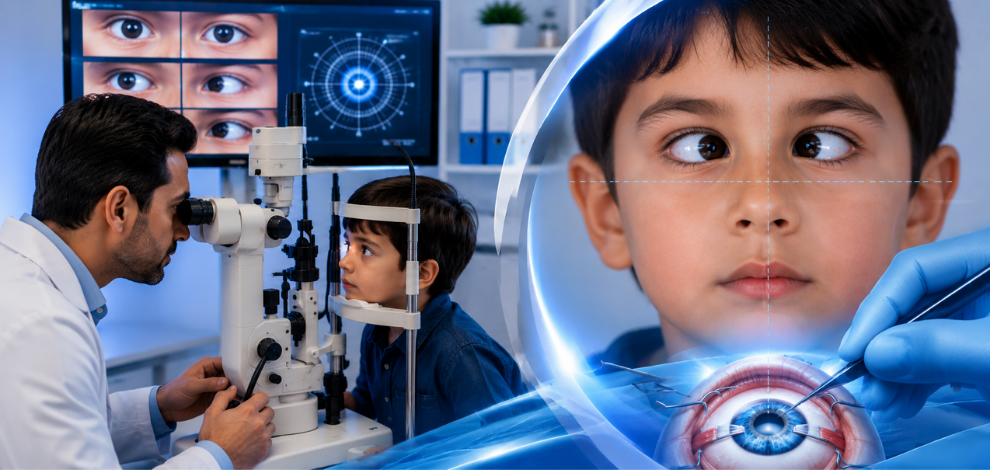
Squint Work-Up & Squint Surgery
Squint, medically known as strabismus, is a condition in which the eyes do not align properly, with one eye potentially deviating in a different direction than the other. At our clinic, Dr. Mahendra Singh provides comprehensive squint evaluation and surgical treatment, helping patients of all ages achieve proper eye alignment and improved visual function.
Understanding Squint and Its Impact Squint can occur due to various underlying causes, including imbalances in the muscles that control eye movement, refractive errors, or neurological factors affecting eye coordination. Beyond its visible cosmetic effect, squint can also impact depth perception, as proper alignment between both eyes is necessary for accurate binocular vision. In children, untreated squint can additionally lead to a condition called amblyopia, or lazy eye, where the brain begins favoring the properly aligned eye, potentially resulting in reduced vision development in the misaligned eye if not addressed in time.
The Squint Work-Up Process A thorough squint work-up begins with a detailed assessment of the direction and degree of eye misalignment, examined both at distance and near focus, and often under various gaze positions to understand how the misalignment behaves. Dr. Singh also evaluates overall eye muscle function, refractive error, and, in children, checks for signs of amblyopia. This comprehensive evaluation helps determine the specific type of squint present and guides the most appropriate treatment recommendation.
Non-Surgical Treatment Options Not all squint cases require surgery. In some instances, particularly when squint is related to uncorrected refractive error, properly prescribed glasses can significantly improve or even resolve the misalignment. In other cases, vision therapy or patching techniques may be recommended, particularly for children with associated amblyopia, to encourage proper visual development in the affected eye before or alongside other treatment approaches.
When Squint Surgery Is Recommended For cases where non-surgical approaches are insufficient or where the degree of misalignment is significant, squint surgery may be recommended to adjust the eye muscles responsible for movement and alignment. This procedure involves carefully modifying the tension or position of specific eye muscles to bring the eyes into proper alignment, a delicate process that requires precise surgical technique.
What Squint Surgery Involves Squint surgery is typically performed under anesthesia, with the specific muscles targeted determined by the type and direction of misalignment identified during the work-up. The procedure involves carefully adjusting the affected muscles to achieve improved eye alignment, with the goal of both functional improvement in binocular vision and cosmetic correction of the visible misalignment.
Recovery After Squint Surgery Following surgery, mild redness, swelling, or discomfort around the treated eye is common and typically resolves within a short recovery period. Follow-up visits are scheduled to monitor healing and assess the resulting eye alignment, with Dr. Singh providing guidance on any additional care or exercises that may support optimal visual outcomes.
The Importance of Early Evaluation in Children Early detection and treatment of squint in children is particularly important, as the visual system continues developing during early childhood years. Timely intervention, whether through glasses, vision therapy, or surgery, offers the best chance of preventing long-term complications such as amblyopia and supporting normal visual development.
Squint in Adults While often associated with childhood, squint can also develop or persist into adulthood, sometimes related to underlying health conditions or previous untreated childhood squint. Adult patients can also benefit from evaluation and treatment, addressing both functional visual concerns and the cosmetic impact of eye misalignment.
Why Choose Our Clinic for Squint Treatment Dr. Singh's surgical training and experience in ophthalmic procedures support careful, precise squint surgery when required, complemented by thorough pre-surgical evaluation to ensure the most appropriate treatment approach is recommended for each individual case.
Taking the Next Step If you notice signs of eye misalignment in yourself or your child, such as one eye appearing to drift or turn differently than the other, scheduling a comprehensive squint evaluation with Dr. Mahendra Singh is an important step toward understanding treatment options and supporting healthy visual development.